La Nuov@ Estate – English version
Banari, from the Ladies' Promenade to the Red Stone Oratory, from the springs to the gardens: truly a jewel of a village
by Mario Bonu
3 MINUTI DI LETTURA
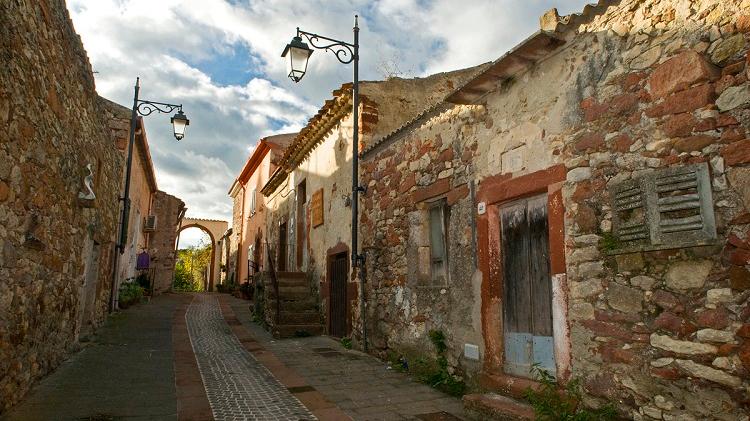
To discover the magic of the 'village of red trachyte', one must lose oneself in the alleyways of Banari's historic centre, amidst stone-faced houses, period palazzos, and flower-decked balconies. And one must conclude the tour at 'Sa caminera', the 'ladies' walk', the narrow street overlooked by the oldest houses in the village which leads to the chapel immersed in a splendid urban park. Few towns like Banari have been able to jealously guard and intelligently restore their past. Therefore, it is no coincidence that this small village of just over 500 souls, has been admitted into the select club of the 'Authentic Villages of Italy', having espoused its founding principles of hospitable community, urban renaissance, intelligent village, community-based cooperatives. The village, part of the Unione dei Comuni del Meilogu (Union of Meilogu Municipalities), lies at the foot of the hill called 'Pala 'e idda', surrounded by mountains and plateaus of red trachyte. Its territory is characterised by the presence of numerous springs and rivers, so much so that according to some scholars the very name Banari may derive from 'ana'ry', meaning 'above the rivers'.
From a historical point of view, the presence of human settlements in the territory is attested starting from the period of the so-called 'Culture of Ozieri' (2500 - 2000 B.C.), which left important traces such as nuraghi and domus de janas. Then the inhabited centre went through all eras, roman, medieval, modern while enriching itself in each of them with testimonies and historical monuments of extraordinary value. Among the things not to be missed in Banari is the parish church of San Lorenzo Martire, donated in 1113 by the judge of Torres to the Camaldolese monks. A short distance from the parish church is the Oratory of Santa Croce, built in the late 16th-17th century, and whose artistic façade in Banari red stone was realised in the early years of the last century. The Romanesque Church of San Michele has been restored several times over the years. Just a few kilometres from the village is the Romanesque church of Santa Maria di Cea (originally Seve), formed by an enclosed courtyard and surrounded by several buildings known as the 'hermitage'. In the area, it is possible to find a faunal oasis called 'Badde manna' and the heights of Corona Alta which are both of great importance for their floristic and faunal variety. There are numerous nuraghi, including Su Crapione, built in local white stone, Sa Tanchitta, built in local red stone, as well as the Nuraghe Corona Alta. Banari also offers a rich traditional gastronomy where vegetables, pulses, sausages and lamb are the main ingredients. However, the golden onion plays the leading role. This is the true queen of local culinary traditions and every year a festival is dedicated to it attracting hundreds of gourmets. This year, the Sagra della cipolla dorata (Festival of the Golden Onion) - organised as always by the Pro Loco with the collaboration of the municipal administration - is scheduled for 22nd July, with the usual moments of debate, entertainment, and the most diverse dishes, from appetisers to desserts, prepared with the Banari onion as a base.
The small centre of the Meilogu also expresses a cultural liveliness that allows it to produce numerous initiatives throughout the year. 'We really have a lot to offer,' says Mayor Francesco Basciu. And indeed, the 4th August of this year 2023 is to be remembered for an evening in collaboration with 'Perda sonadora' of Seneghe, with a tribute to the memory of the great poet Barore Sassu, and to the living poet Angelino Porcheddu. Another appointment not to be missed is on 14th August with a Time in Jazz stage in 'Sa Caminera', with Gianni Cazzola Young Italian Quintet as guest. Then 'Carrelas in festa', the two-day event that takes place in mid-December and includes exhibitions, itinerant music, and typical productions.
Non lasciare decidere l'algoritmo:
scegli La Nuova Sardegna per le tue notizie su Google