La Nuov@ Estate – English version
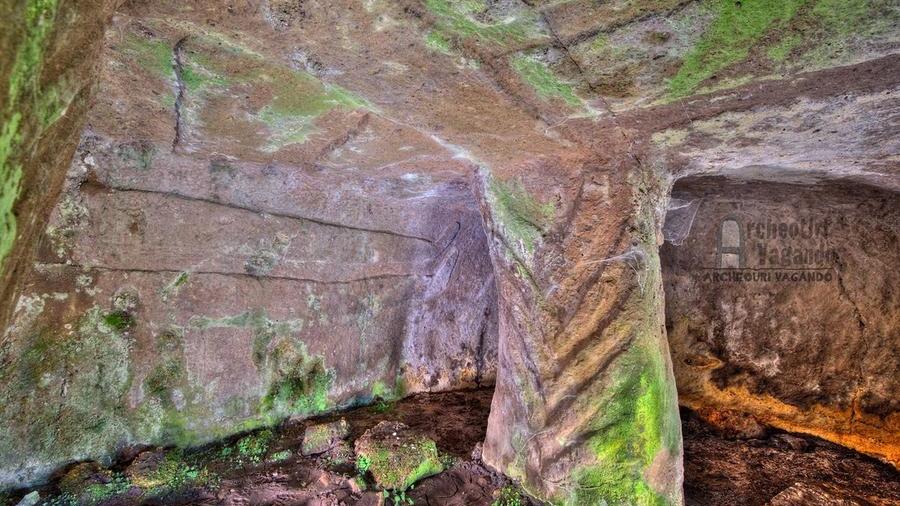
In Bessude we start from a unique discovery: the Tomb of the Sculpted Pillars
by Mario Bonu
◗
La tomba dei pilastri scolpiti nel Meilogu4 MINUTI DI LETTURA
Evocative by name, the 'Tomb of the Sculpted Pillars' is one of the unmissable gems of the Bessude area. It is a domus de janas that is part of the 'Enas de Cannuja' necropolis (seven domus in all) that has two sculpted columns inside, and is adorned with a series of impressive graphites. Ercole Contu former archaeologist, university lecturer and Superintendent of Antiquities for the provinces of Sassari and Nuoro discovered this. Instead, in the town centre, in an equally evocative site 'sa domo de sas damas', we find another of Bessude's most precious jewels the 'MuMe' (Museo Meilogu Medievale). This Museum is a true treasure chest of knowledge of the territory and the entire Meilogu, set up in 2013 by the municipal administration with the collaboration of the University of Sassari and managed by the 'ProMeilogu' association. The museum offers a complete and rigorous view of the history of the Meilogu in the Middle Ages Through exhibits, illustrative panels, photo and video documentation. The third unmissable attraction of the village of Bessude, this time in the gastronomic field, are the celebrated 'ciciones' and 'sa mendula bellinda'. The first, which can be defined by a more generic name gnocchetti sardi di pasta fresca, are famous for their small size. Handmade in the classic 'chiliros', reed sieves, and produced with simple, natural ingredients (semolina and durum wheat flour, salt and water) sos ciciones de Bessude, seasoned with 'su ghisadu', are appreciated and sought after for their unique taste. 'Sa mendula bellinda' which is a true delicacy exclusive to Bessude, is instead a sweet made of peeled and roasted almonds, sugar, water and lemon peel, skillfully blended by hands that know and preserve the ancient recipe handed down from mother to daughter. In August, there is a festival dedicated to the two dishes that attracts hundreds of gourmets every year.
'But in addition to these and other treasures,' says Mayor Roberto Marras, 'Bessude offers an unspoilt environment and nature, as well as a tranquility that makes a stay in our centre particularly pleasant.”
The village, with a population of 382 inhabitants, is part of the Unione dei Comuni del Meilogu. It is currently divided into two areas, the historical centre and the new quarter, called 'Sa sea'. Human presence in the area is demonstrated, in addition to the aforementioned site of Enas de Cannuja, by nuraghi and domus de janas, including the 'Fumari' complex on Mount Pelao, which includes the nuraghe of the same name, a group of domus de janas, and a small Roman necropolis.
In the Judicial period - 1000-1410 - the village was part of the curatoria of Cabuabbas. It then followed the destiny of the villages there, remaining under the rule of the Doria for a long time until 1436. Of the long feudal period (14th- 19th century) we remember the final part, when the community of Bessude became the protagonist of the anti-feudal uprisings, signing with Thiesi and Cheremule (November 1795) the first of the anti-feudal pacts of the Logudorese populations and then participating (October 1800) with 150 armed men in the defence of Thiesi. In this case, the authorities suppressed the revolt with the dispatch of 1500 men.
Evidence of the different historical phases of the village is the parish church of San Martino, which dates back to the early 17th century and houses a precious painting of the saint, presumably contemporary with the building of the church. Then there is the mediaeval church of San Leonardo, of fine architecture, where the ancient cemetery was located, and the church of Santa Croce, with external buttresses, which was formerly the oratory of the confraternity of the same name.
Outside the village, the 14th-century church of Santa Maria de Runaghes is located in the 'Cunzadu de cheia' region. Another feature that characterises the centre of Bessude are the murals, among which stands out that symbol of tradition and modernity proposed by the old man riding a Vespa with a long white beard and traditional dress. An artefact that always attracts the curiosity of those about to visit the village.
Non lasciare decidere l'algoritmo:
scegli La Nuova Sardegna per le tue notizie su Google