La Nuov@ Estate – English version
Putifigari, medieval village with two passions good food and stone working
by Franco Cuccuru
◗
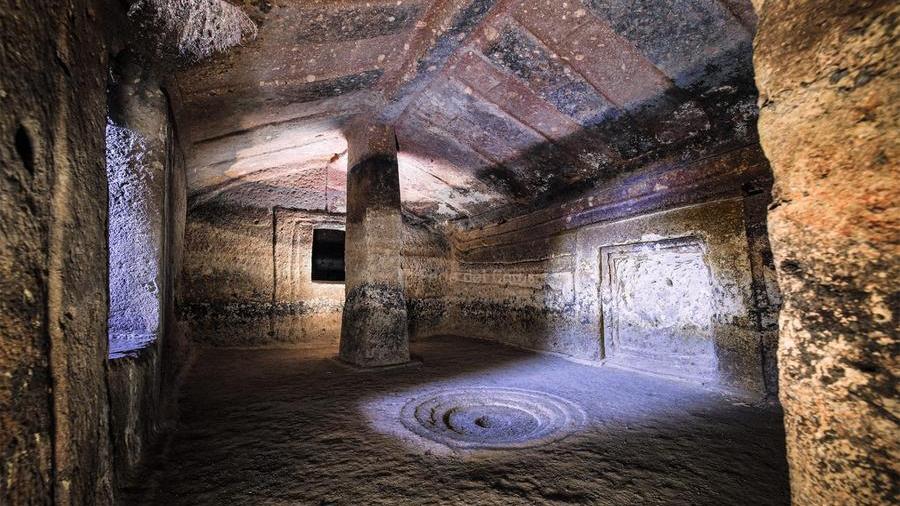
Putifigari la Tomba di S'Incantu3 MINUTI DI LETTURA
A hilly municipality of ancient origin, Putifigari an agro-pastoral village, rises on the slopes of a hill 267 meters above sea level, located inland from the Alghero coast and can be reached by the SS127bis Settentrionale Sarda, whose route runs about eight kilometers from the town. The surface of its territory is predominantly hilly and the main watercourses are torrential in character. The municipal territory has an irregular geometric profile, with very marked elevation changes. Putifigari, its name, which in local parlance is Putivigàri or Potivigàri, derives from the Sardinian Logudorese Púttu, meaning a Well, and from the term Ficus, meaning a Fig Tree. The municipality bases its economy mainly on traditional farming and animal husbandry. Putifigari is also renowned for stone working; there are many wall masons even of young age. It has a popular craft workshop “Oasis of Fresh Pasta”, where fresh pasta and sweets typical of the village are produced. The receptive apparatus offers catering and accommodation possibilities with two active facilities and a rooming house. The origins of its territory are traced back to prehistoric times, as attested by the findings made there. As a town, however, Putifigari was born in medieval times, when it belonged to the Giudicato of Logudoro, in the curatoria of Fiolinas. In 1255, with the death of Adelasia of Torres, it became a possession of the Dorias, who administered it for some time. Passing under the control of the Aragonese, around 1365 King Peter IV of Aragon granted the fief to Don Pedro Boyl, who designed its general layout, had new houses built there and renovated the old Baronial Palace. In the 17th century, the Boyl family became related to the Pilo family through the marriage of Margaret Boy to Don Matteo Pilo. As a result of this event, repopulation policies began to be implemented, which also brought there the presence of criminals condemned to confinement. The municipality of Putifigari in 1928 was aggregated with the municipality of Villanova Monteleone, but in 1947 it was again separated from it. Among the main festivals and feasts held in Putifigari are the patronal festival in honor of the Blessed Virgin of S'Ena Frisca on the third Sunday in May and the Mycological and Ethnographic Exhibition in the first week of November, during which different varieties of mushrooms collected in the area are exhibited. The parish church of Signora de S'Ena Frisca, overlooking Boyl Square, was built around 1597. It was restored in the 18th century by Pio Boyl, the last Count of Monteleone. The Hypogeic Necropolis of Monte Siseri is one of the largest in Sardinia; it consists of three tombs, excavated in a natural amphitheater of pinkish-colored trachytic tuff. The first two tombs are close to each other, while the third is a short distance away. Most famous of the necropolis is Tomb I, also called the Tomb of S'Incantu, which has painted walls and is rich in symbolic figures carved in relief. Significant in this tomb is the reproduction of the double-pitched ceiling, typical of the housing of the living. Currently, the hypogeum can be visited after booking for excursions by calling the municipality's telephone numbers.
«Until two years ago, the village was a stranger to depopulation. It had about 730 inhabitants since 1980. In recent years several young people have left in search of work – said Mayor Giacomo Contini –. Putifigari is a few kilometers from the sea, the mountains, the port and the airport that's why people stay in the village. However, seen the worsening of the essential citizen services, some people are inclined to move away from the village. We have to make sure that this does not happen».
Non lasciare decidere l'algoritmo:
scegli La Nuova Sardegna per le tue notizie su Google