La Nuov@ Estate – English version
Anglona, from the Palaeolithic to the future between rituals and gastronomy
by Mauro Tedde
◗
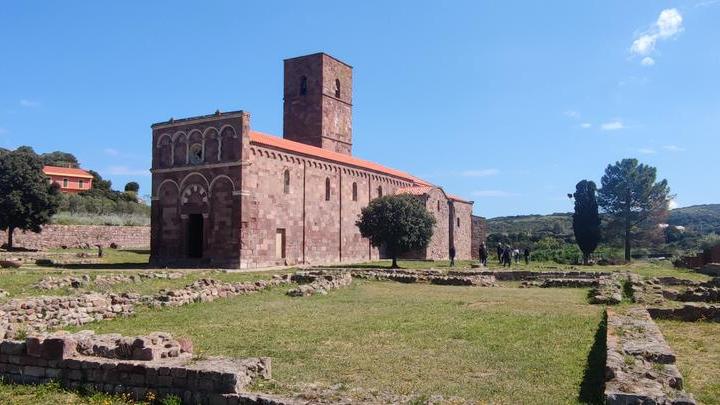
La Chiesa di Nostra Signora di Tergu2 MINUTI DI LETTURA
The historical region of Anglona, nestled between Gallura, (the Coghinas river demarcates this eastern border very well), Logudoro and Romangia owes its name to the Byzantines (meaning 'corner' or perhaps 'river bend'). An ancient land of many contrasts, the remains of petrified forests are visible in its territory, but, above all, here was found (in 1979) the oldest evidence of human presence in Sardinia. Along the rio Altana-Anzos, six deposits have returned a considerable quantity of flint artefacts dating back to the Palaeolithic period. But Anglona is also very rich in artefacts from the pre-Nuragic period, the Bronze Age, the Phoenician-Punic and Roman periods, the Middle Ages (the land belonged to the Giudicato of Torres) and, of course, the Aragonese period. An infinity and variety of palaeobotanical and archaeological sites (nuraghi, sacred wells, funerary hypogea, tombs of the giants) and stupendous Romanesque churches sprinkle its hills and valleys. In addition, its ethno-anthropological and environmental heritage is of great interest. This is characterised by languages, rituals, customs, knowledge and beliefs that are unique in Sardinia. This territory also offers a thermal site, interesting museums, castles and several trekking trails with panoramic viewpoints of high environmental and naturalistic value. Important economic activities in the region are livestock breeding, agriculture, trade, handicrafts and quality agri-food production.
In short, a huge historical and environmental heritage that the Unione dei Comuni dell'Anglona e Bassa Valle del Coghinas, a body set up to manage inter-municipal associated functions based in Perfugas, which is trying to rediscover and enhance in many ways and in a unified manner. The Union is composed of the municipalities of Bulzi, Chiaramonti, Erula, Laerru, Martis, Nulvi, Osilo, Perfugas, Santa Maria Coghinas, Sedini and Tergu. A modern and enlightened body that seeks to overcome ancient parochialism and goes in search of its common roots and regional identity. A cultural fact but also an attempt to escape the ancient protection of Sassari and Gallura by a relatively small territory squeezed between two powerful realities.
"The main objective of our organisation is the univocal and coordinated promotion of our rural communities,' explains Giovanni Ligios, president of the Union of Municipalities of Anglona and Mayor of Osilo, 'through the creation of a territorial brand that is able to enhance the quality tourist and agri-food attractions and convey the great cultural and environmental heritage of our municipalities. We will work to accelerate the transformation of our communities, so as to make them a prestigious reference point for the rural and experiential holiday tourism segment in the shortest possible time, a stone's throw from the beautiful coastline of north-west Sardinia'.
Non lasciare decidere l'algoritmo:
scegli La Nuova Sardegna per le tue notizie su Google